US midterms and the compliance ripple: What the result means
- Anti-Money Laundering (AML)
- Ongoing Monitoring
- Banking
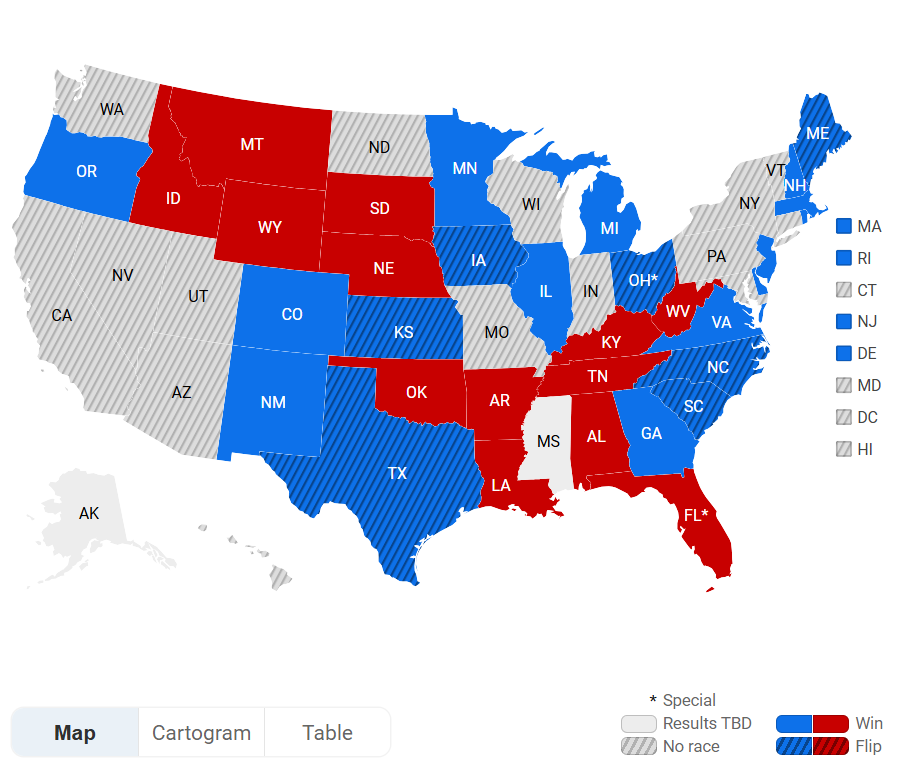
The United States now moves into two years of divided government, with a Republican administration in the White House and Democratic majorities in both chambers of Congress. The next Congress begins in January 2027.
For UK compliance teams, the connection between American political events and daily operational compliance work is already well understood. Our 2026 Compliance Reality Check, which surveyed 1,000 senior decision-makers across UK regulated sectors, found that 96% identify geopolitical factors as a major influence on their compliance strategy over the next 12 to 18 months. 11% named changes to international sanctions and embargoes as the single biggest geopolitical risk they are tracking. 15% named cross-border regulatory divergence. The sector is already alive to the exposure. The question for the week after the midterm result is sharper: what specifically can we now expect, and what does that mean for the operational decisions UK firms will be making through Q1 and Q2 of 2027?
A vote in Washington can change your sanctions obligations in Wakefield. That is not a new idea to UK compliance teams. It is the operating reality they've managed for years, and this result confirms the direction of travel.
What the result tells us about the next 12 months
Divided government is now the operating environment for the rest of this administration. In practical terms, that means legislative gridlock on major policy change, more intensive congressional oversight of agency rulemaking, more scrutiny of administrative actions, and more friction between the executive branch and a Congress controlled by the other party. For UK firms watching the US regulatory picture, that translates into a specific pattern. Agency rulemaking will continue, but more slowly and under more pressure. Executive actions on foreign policy and sanctions will continue, but with more congressional pushback. Legislative solutions to current regulatory uncertainty are less likely to land in the near term.
That is useful intelligence for UK compliance teams because it points to which parts of the US regulatory picture are likely to shift rapidly, which are likely to stall, and which are likely to become sites of active disagreement between the executive and legislative branches. Sanctions sit in the first category. Agency rulemaking on bank capital, crypto and markets sits in the second. Tariff and trade policy sits in the third.
Sanctions: the most immediate operational consequence
The US sanctions landscape is where the midterm result will land soonest and most materially for UK firms. The US sanctions regime, administered principally by OFAC, has global reach, and UK firms with any US customers, US counterparties, US correspondent banking relationships, US-linked corporate structures or US dollar-denominated transaction flows are directly exposed to how the US sanctions perimeter is drawn and enforced.
With Democratic majorities in both chambers, legislative action on sanctions will be a reality through 2027 and into 2028, and that action may in several areas diverge from the administration’s own direction. Iran is the area where cross-party disagreement has been sharpest over the last five years, and the next 18 months are likely to see active contestation between executive and legislative preferences. Russia sits in a similar position, where UK and EU positions have been closely aligned and the US position has been more contested. China is the third area to watch, where cross-party consensus on some issues coexists with sharp disagreement on others.
The practical implication for UK compliance teams is that the OFAC list, the OFSI list and the EU consolidated list need to be treated as three separate inputs, not as roughly equivalent references. The gap between them has widened over the last two years. The midterm result is likely to widen it further. UK firms running ongoing sanctions monitoring against all three lists, with automated re-screening when any of the three updates, are positioned well for what is coming. UK firms still running periodic or event-triggered screening against a single primary list are carrying exposure that will become visible quickly.
Regulatory divergence: the harder question
The slower-moving but arguably more significant consequence of the midterm result is in regulatory divergence between the US and the UK and EU. US financial services regulation is a major benchmark in the global regulatory conversation. Any significant shift in bank capital requirements, crypto asset oversight, merger review thresholds or market structure rules in the US creates a divergence with the UK and EU equivalents, which UK firms doing cross-border business then have to manage.
Several specific areas are worth tracking through Q1 2027 and beyond.
The Digital Asset Market Clarity Act, which passed the US House in July 2025, was rejected by the Senate on a 49-50 procedural vote in September. With Democrats now controlling the Senate, the proposal in its current form is unlikely to progress. A renewed legislative effort would need to find bipartisan ground that did not exist before the midterms. In the meantime, the SEC has moved independently on custody rules for crypto assets, with a public comment deadline in early December. The UK is now on a different trajectory, with the FCA’s own crypto asset regulation regime landing from October 2027. UK firms with cross-border crypto exposure will be managing two regulatory regimes that are moving in different directions.
Bank capital requirements are moving on their own timetable. The Federal Reserve, FDIC and OCC proposed revised capital requirements back in March, and those proposals are still in the comment period. Under divided government, agency rulemaking is likely to face more congressional scrutiny, which could slow finalisation or alter the final form. UK firms with US banking relationships will be reading the next twelve months carefully, because the direction of divergence between UK and US capital frameworks matters for how cross-border positions get priced.
Tariff policy sits in a specific category of its own. A Supreme Court decision in February held that a federal emergency-powers law did not authorise tariffs, which narrowed the administration’s unilateral authority. A Democratic Congress is unlikely to legislate new tariff authority, which creates a specific policy environment UK exporters, UK importers and UK firms with cross-border supply chains need to plan against. For compliance teams at firms with meaningful US exposure on goods flows, this matters for everything from customer due diligence on US counterparties to beneficial ownership verification on US corporate structures.
Merger reporting sits alongside this. The FTC raised the basic size-of-transaction reporting threshold in February as part of its annual statutory adjustment. Under divided government, merger enforcement at the FTC and DOJ is likely to face more scrutiny, which could translate into both stricter review of individual transactions and more challenged thresholds in future rounds. UK firms involved in cross-border M&A will be factoring this into their 2027 deal pipeline.
Where UK firms can put the intelligence to work
For UK compliance leaders already treating geopolitics as a compliance input, the midterm result is useful specifically because it clarifies the shape of the next 12 to 18 months. There are several practical moves worth considering off the back of it.
Sanctions screening frequency and coverage is the first lever. For firms where current screening runs against a single primary list periodically, the next 12 months are the moment to move to continuous monitoring against OFAC, OFSI and the EU consolidated list in parallel. The risk of missing a divergence between the three is higher than it has been for several years.
Firm-wide risk assessment currency is the second. The 2025 NRA and the Fraud Strategy 2026 to 2029 both flag geopolitical change as a material factor. For UK firms whose risk register has not been refreshed since the midterm results, it is worth doing so, specifically to acknowledge the current US divergence picture as a live input rather than a watching brief.
Scenario planning is the third discipline worth building. Not predictions. Scenarios. What happens to sanctions screening workload if OFAC designates 500 new entities in a Q2 action? What happens to KYB workload if the EU and US take divergent positions on a specific sector? What happens to US dollar correspondent banking if a major counterparty jurisdiction is reclassified? The firms that have modelled these scenarios can absorb them as they land. The firms that haven’t will spend the next twelve months catching up.
The through-line to the Compliance Reality Check
The midterm result and the 96% stat from our own research are telling the same story from two directions. 96% of UK regulated firms identify geopolitical factors as a major influence on their compliance strategy. That is the view from inside the sector: firms are managing the exposure already. The midterm result- the resulting divided government, the sanctions and regulatory divergence that follows- is the view from outside: political events producing material compliance consequences for UK firms every month, from different parts of the world, in different combinations.
Our research also found that 24% of UK regulated firms identify AI-generated fraud as the biggest emerging threat they face, 54% are still conducting identity checks manually, and 52% struggle to verify beneficial ownership in complex structures. Each of those gaps is made harder by geopolitical volatility, because political change tends to produce exactly the kind of fast-moving regulatory environment where manual processes and single-source checks fall behind. The specific capability gap, between firms running triangulated identity verification, continuous ongoing monitoring across multiple sanctions and PEP lists, and integrated KYB on complex corporate structures, and firms still running manual processes, becomes commercially visible fastest in exactly these environments.
Geopolitics isn’t background noise for compliance. It is the weather, as every UK compliance team already knows. The midterm result is the specific weather forecast for the next 12 to 18 months. The firms that use it to inform their 2027 operational decisions will be the ones best placed for what comes next.
Sources
- Sky News, US Midterms Live Results and Analysis, November 2026
- Economic Insider, “How the 2026 Midterm Elections Could Shift U.S. Market Rules,” November 2026
- Fintech Global, “Why the 2026 Midterms Could Expose Compliance Blind Spots,” October 2026
- Radical Compliance, “Ethics, Compliance and the Midterms,” November 2026
- Home Office, National Risk Assessment of Money Laundering and Terrorist Financing 2025
- Home Office, Fraud Strategy 2026 to 2029: Disrupting Crime, Supporting Economic Resilience and Delivering Justice, published 9 March 2026
- US Securities and Exchange Commission, Proposed Crypto Asset Custody Rules, published October 2026
- Federal Reserve, FDIC, OCC, Proposed Revisions to Bank Capital Requirements, published March 2026
- Federal Trade Commission, Merger Reporting Threshold Adjustments 2026
- UK Office of Financial Sanctions Implementation (OFSI), Consolidated Sanctions List
- US Office of Foreign Assets Control (OFAC), Specially Designated Nationals List
- European Union, Consolidated List of Financial Sanctions
- SmartSearch, 2026 Compliance Reality Check, based on 1,000 senior decision-makers across UK regulated sectors
See it in action
Get in touch with our team of experts today to discuss your business requirements and how SmartSearch can help with a bespoke solution.