

AML Checks & Compliance Software for Accountants
AML Compliance for Accountants
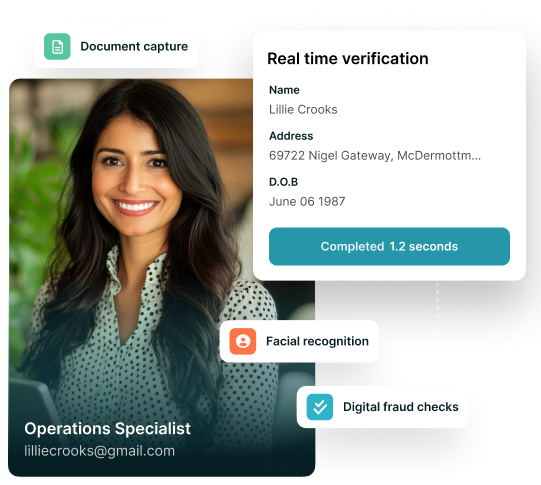
Protect your accountancy firm against financial crime and streamline compliance with SmartSearch’s AML software. Verify individual and business clients with KYC and KYB checks, identify UBOs, apply risk-based CDD and EDD, screen for sanctions and PEPs, and keep client risk under ongoing review from onboarding onwards.
AML Obligations for Accountants
Accountancy firms must take a risk-based approach to AML compliance, including Customer Due Diligence, beneficial-owner checks, record keeping, staff controls and a business-wide risk assessment.
Firms should also keep client risk under review and have clear procedures for identifying, escalating and reporting suspicious activity.
The SmartSearch Difference
Onboard and Verify Clients with Confidence

Apply Risk-Based Due Diligence and Ongoing Monitoring

Solutions for Accountants
-
KYC checks for accountants
Electronically verify your customers and meet your due diligence obligations with the help of our automated facility for PEP and Sanction warning alerts.
-

A centralised solution
Our platform completes AML and KYC check all in one place - and can even integrate with your existing system - streamlining your AML procedures and enabling you to verify your entire client base through one user-friendly interface.
-

Conduct your due diligence
Through our due diligence dashboard we ensure identification, verification and ongoing monitoring are completed on all your customers ensuring you can remain fully AML compliant at all times.
-

Manage monitoring
Our daily monitoring service takes updates from the world's most accurate and up-to-date PEP and Sanctions list in the world so we can alert you if any of your client's statuses change.
-

Mitigate the risk of fraud
We offer a wide range of comprehensive anti-fraud services that can be tailored to create a bespoke fraud prevention solution for your business.
-

Evidence your compliance
With the SmartSearch solution, you are always audit-ready. We can even retrospectively batch-upload existing customer bases to ensure a clean, compliant position.
Empowering Accountancy Firms with Secure Identities
Identify customers in seconds
Our AML and compliance platform offers triple-bureau reliability for the highest pass rate on the market of up to 97%.
Enhance client relationships
Robust anti-money laundering protocols can help to enhance a client's faith in a company and their services.
Protect your reputation
A company's most precious asset is its reputation and even accidental involvement in money-laundering or illegal transactions can harm a company's reputation.
A company's most precious asset is its reputation and even accidental involvement in money-laundering or illegal transactions can harm a ...
Reduce compliance risk
Avoid illicit activity that could expose your business to crime and criminal liability by screening their clients and transactions.
Integrate SmartSearch’s capabilities into your own system
SmartSearch can help you with every step of your AML compliance, right through from initial checks to ongoing monitoring – but we can also adapt our products to suit you.
Whether you’re a part of a large accountancy firm or an individual practitioner, we’re able to integrate our services with your existing software, so you can run AML checks using information from your own system.
Advanced delivers robust, cutting-edge solutions for optimised business operations.

Alto Software offers a comprehensive cloud-based property management solution for estate agents.

Wealth Dynamix provides CLM solutions for wealth management.

Salesforce streamlines sales, marketing, and customer service with its CRM tools.
Worxinfo creates efficient, tailored data systems for organisations.
Our services are used by 1 in 2 of the top 100 accountancy firms

The platform is easy to use and very user friendly – we’re able to verify client’s identities within a few clicks, making the process of onboarding clients straightforward. The search results are also concise and easy to understand.
Meyrick Field
Governance Compliance and Quality Lead
Our compliance department especially benefits from the wide range of information SmartSearch incorporate into their platform, giving us a clear result once the check is complete
J A Black
Partner
After an extensive review of multiple providers, we decided on SmartSearch for our AML procedures as it was the best platform we had seen and offered everything we need to ensure we are fully compliant.
Charter Tax
How our resources can support you
-
Resource library
Explore our resource library for expert guides and tools to support your compliance processes.
-
Blogs
Discover our latest blog posts for expert tips, features, industry trends and more.
-

Frequently Asked Questions
According to the Serious Fraud Office, there are three key tell-tale signs which accountants should look out for when trying to prevent money laundering. These are as follows:1. If a long-term client or customer behaves oddly, or makes uncharacteristic requests. 2. A client or customer asks you to make financial arrangements which don’t make sense commercially. 3. A client or customer asks you to provide services which are outside your area of expertise, and does so on multiple occasions.
There are some fifteen different supervisory bodies responsible for monitoring the AML compliance of accountants, bookkeepers and other financial advisers, but these bodies are in turn overseen by the OPBAS. These regulatory bodies include the Association of Accounting Technicians, the Association of Chartered Certified Accountants, the Financial Conduct Authority and the Institute of Financial Accountants. To see a full breakdown of the supervisory bodies for this sector, visit GOV.UK.
Yes, sole practitioners still need to ensure that they are AML compliant. The Money Laundering Regulations 2007 stated that any company OR individual that is providing accountancy services must be registered with an appropriate supervisory body, so their AML compliance can be monitored.
Serious consequences, such as hefty fines, criminal prosecutions, and reputational harm, can arise from failing to meet AML requirements. Partners and staff members of the company can occasionally be held personally accountable and a fraud or failure to comply can significantly damage the reputation of a company.
Electronic verification is widely recognised by regulators, product providers and professional bodies as probably the most reliable, secure and efficient source of information for identity solutions. Regulators need to remain impartial so don’t recognise any particular supplier.
Using EV is by far the most reliable way to carry out know your customer and know your business checks on new and existing clients. As criminals produce ever-more sophisticated fraudulent versions of documents like passports and driving licences, EV can also verify official documentation quickly and reliably.
Accountancy firms providing services within the scope of the Money Laundering Regulations need appropriate AML checks and controls. This can include accountants, bookkeepers, tax advisers, payroll providers and sole practitioners, depending on the services they provide and their supervisory arrangements.
A structured onboarding process can include collecting client or business details, completing KYC checks or KYB checks, identifying beneficial owners, screening for sanctions and PEPs, assessing risk and applying proportionate CDD or EDD before approval.
KYC checks verify individual clients, while KYB checks verify companies and relevant associated parties. For business clients, KYB can include company information, directors, ownership structures and linked beneficial owners.
Where a client is a company or other legal entity, firms should identify and verify the individuals who ultimately own or control it where required. UBO checks can support this by reviewing ownership structures, PSCs, directors and connected individuals.
Customer Due Diligence establishes and verifies the client and supports the assessment of financial-crime risk. Enhanced Due Diligence involves additional checks where the client, ownership structure, geography, funding, activity or screening results indicate higher risk.
Sole practitioners carrying out regulated accountancy services still need appropriate AML controls. Their procedures should be proportionate to the size and nature of the business, but relevant obligations around risk assessment, CDD, monitoring, record-keeping and suspicious activity still apply.
Unusual transactions, unexplained ownership or funding, inconsistent client behaviour or activity without a clear commercial rationale may require further investigation. Firms should follow their internal escalation process, document the evidence and decisions, and make a suspicious activity report where appropriate.
Client risk should continue to be reviewed after onboarding. Changes to ownership, directors, services, expected activity, sanctions or PEP status, adverse media, or other risk factors can trigger further due diligence and ongoing monitoring.
A clear AML audit trail can include identity and business evidence, ownership information, risk assessments, screening alerts, analyst notes, referrals, approvals, compliance certificates, and review history. These records help demonstrate how the firm applied its AML policies and decisions.
Yes. AML checks can be connected with existing practice-management and client workflows through integrations and APIs, helping firms initiate checks, retrieve results, manage alerts, and retain compliance information more efficiently.
See it in action
Let one of our highly-trained AML experts demonstrate the multi-award winning SmartSearch AML and compliance product.