

FCA Motor Finance Redress: What the March 30th Rules Mean for CMCs and Law Firms
What the FCA confirmed on March 30th
The final rules published yesterday confirm an £11 billion redress scheme covering up to 14 million mis-sold motor finance agreements between 2007 and 2024. This follows the Supreme Court's August 2025 ruling that certain motor finance agreements constituted an unfair relationship under the Consumer Credit Act 1974 due to undisclosed commission arrangements.
Key details:
- Implementation period: 3 months for most agreements, up to 5 months for older agreements
- Complaint window reopens: May 31st, 2026
- Scheme scope: Regulated motor finance agreements from April 6, 2007 to November 1, 2024 where commission was paid by lender to broker
- Redress methodology: Includes discretionary commission arrangements (DCAs), high commission arrangements (over 35% of cost of credit), and exclusive contractual ties
Consumers who complained before the scheme starts won't need to opt out. Within three months of implementation end, they'll be told whether they're owed compensation and how much.
What this means for CMCs and law firms
The March 30th announcement gives the industry just six days to understand the final rules before the implementation period begins in earnest. But here's the critical point: the FCA and SRA's compliance expectations haven't changed.
The February 4th joint warning demanding "robust checks" and proper due diligence remains in full force. With 89 investigations underway and 7 firms already closed, regulatory expectations on client verification are unchanged.
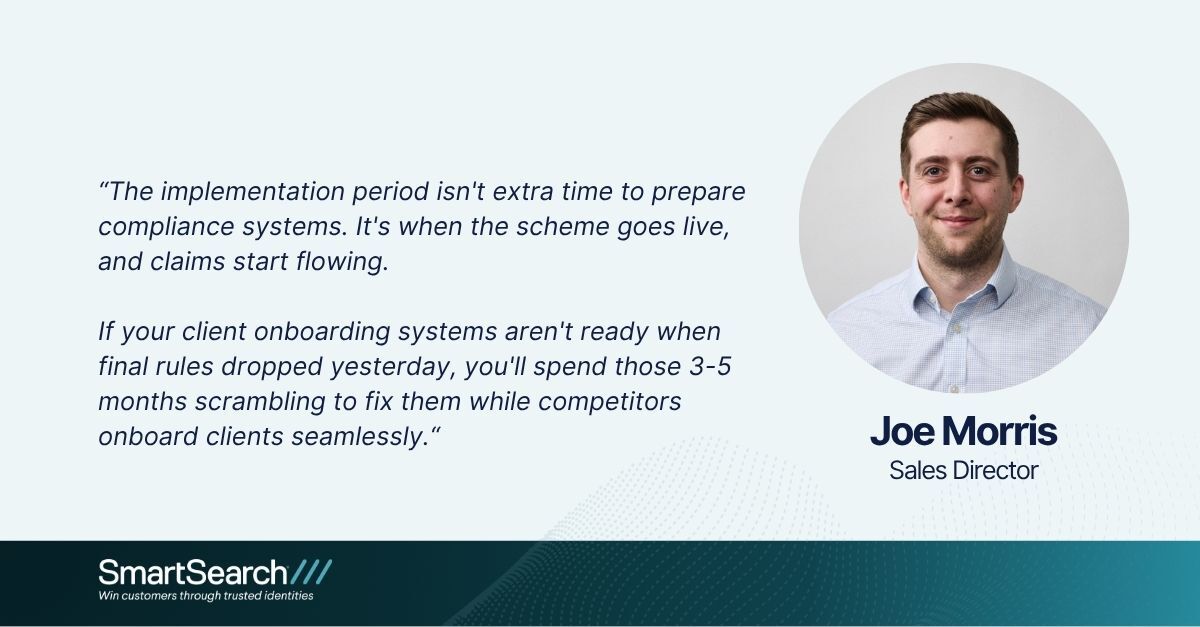
The implementation period isn't extra time to prepare compliance systems. It's when the scheme goes live and claims start flowing. If your client onboarding systems aren't ready when final rules dropped yesterday, you'll spend those 3-5 months scrambling to fix them while competitors onboard clients seamlessly.
The compliance gap that's catching firms out
According to recent legal analysis from Pinsent Masons, enhanced regulatory obligations on financial service providers are requiring firms to play an increasingly proactive role in protecting consumers from fraud and financial abuse. This shift is reshaping consumer protection and mass claims across financial services in the UK and Ireland.
The same principles apply to CMCs and law firms handling motor finance claims. Robust client verification isn't a nice-to-have - it's a regulatory requirement that will be scrutinised under FCA and SRA enforcement.
What "robust checks" actually means in practice
The FCA and SRA joint warning wasn't ambiguous. Robust checks require:
Digital identity verification - Manual document review is vulnerable to sophisticated forgery techniques. Deepfake technology can now create convincing identity documents that pass visual inspection but fail biometric liveness detection. SmartSearch's biometric verification achieves a 99.8% deepfake catch rate.
Real-time sanctions and PEP screening - You need access to comprehensive, continuously updated sanctions lists. SmartSearch maintains 1,100+ global sanctions and PEP lists updated every 24 hours with AI-enabled alert triage to reduce false positive noise.
Automated UBO verification - When clients are corporate entities, you need to verify ultimate beneficial ownership across unlimited corporate layers. Manual Companies House research doesn't scale.
Ongoing monitoring - Verification isn't a one-time event. Ongoing monitoring throughout the client lifecycle catches changes in risk profile, sanctions status, or beneficial ownership.
Audit-ready documentation - When the FCA or SRA comes knocking, you need to demonstrate compliance with clear audit trails and compliance certificates.
Two types of firms emerging
We're seeing the industry split into two groups:
The prepared firms: These firms followed the February 4th FCA/SRA guidance and implemented robust verification systems in March. They're onboarding clients confidently from day one of the implementation period. Their compliance systems are tested, their staff are trained, and their audit trails are clean.
The scrambling firms: These firms waited to see what the final rules would say. Now they're trying to retrofit compliance systems while trying to handle incoming volume. They're risking enforcement action, client delays, and reputational damage.
The window to prepare has closed
March 30th was decision day for the industry. The final rules are published. The implementation clock is ticking. The complaint window opens May 31st.
From that moment, the three-month implementation clock started ticking. CMCs and law firms that followed the FCA/SRA's February 4th guidance and implemented robust verification systems are ready to process claims immediately.
Those that didn't now face a critical choice: pause client onboarding while they fix their systems, or risk handling claims with inadequate checks and face the enforcement consequences we've already seen with seven firms closed and 89 investigations underway.
What SmartSearch provides
SmartSearch supports over 7,500 regulated businesses with compliant client verification:
- Digital identity verification: Browser-based verification across 200+ countries, completed in under 60 seconds
- Biometric liveness detection: 99.8% deepfake catch rate
- Sanctions and PEP monitoring: 1,100+ lists updated every 24 hours
- Automated UBO verification: Unlimited corporate layer verification with Companies House integration
- Ongoing monitoring: Continuous monitoring throughout client lifecycle
- Audit-ready compliance: Automated certificates and documentation
Implementation time: under one week.
The smart money invested in compliance early. The rest are about to find out what that delay costs them.
If your firm isn't ready yet, you have weeks - not months - to get compliant systems in place before the complaint window opens and volume hits.
See it in action
Whether your prospective client is a corporation or an individual, our all-encompassing AML solution covers every base, so your business is protected.