
How wealth managers, lenders and financial services firms are using Source of Funds
- Anti-Money Laundering (AML)
- Monitoring & Reporting
- AML For Enterprise
- Source of Funds

For many compliance professionals, Source of Funds is still closely associated with property transactions.
The image is a familiar one. A conveyancer requesting bank statements before exchange. A buyer providing evidence of a deposit. A compliance team reviewing documents shortly before completion.
While property remains one of the most visible use cases, the underlying compliance obligation has always extended much further.
Any regulated firm handling a transaction where the origin of money needs to be understood faces essentially the same challenge. Whether that transaction involves an investment into a portfolio, a capital contribution towards a lending facility, a significant deposit into a financial product, or the receipt of client funds as part of a professional services engagement, firms need to understand where the money has come from and be able to evidence that understanding if challenged.
The regulatory focus on Source of Funds has intensified considerably in recent years. The Economic Crime and Corporate Transparency Act (ECCTA), continued scrutiny from regulators, expected amendments to the Money Laundering Regulations and broader financial crime concerns reflected within the National Risk Register have all pointed in the same direction: regulators increasingly expect evidence, consistency and defensible decision-making. Firms are being asked not simply to conduct checks, but to demonstrate how and why they reached their conclusions.
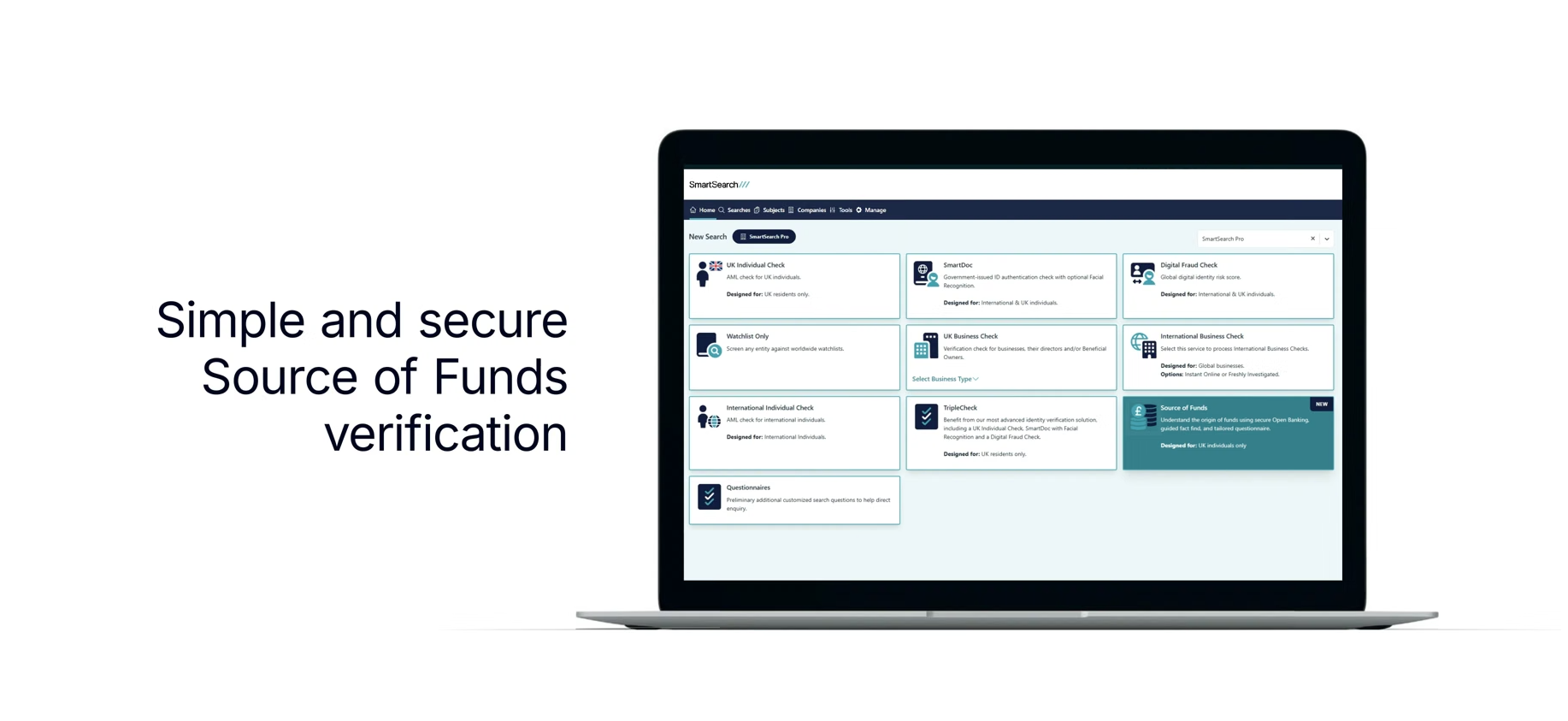
This is why SmartSearch has expanded its Source of Funds capability beyond its traditional property focus.
Alongside specialist property workflows, firms can now access configurable Standard and Refresh journeys designed to support a broader range of regulated transactions.
The core challenge remains the same.
The applications are becoming much wider.
Wealth Management and Investment: Understanding the Origin of Client Contributions
Source of Funds has become increasingly important across the wealth management and investment sectors.
When a client makes a significant investment, opens a portfolio or transfers substantial assets into a new arrangement, firms are expected to understand where those funds originated.
That may sound straightforward in principle.
In practice, the reality can be far more complex.
Funds may have accumulated through years of salary savings. They may represent proceeds from the sale of a business, gains from an investment portfolio, inheritance funds or capital released from property transactions. In many cases, the money may have moved through multiple accounts over an extended period.
Each scenario creates different evidential requirements.
Historically, gathering that information often involved lengthy email exchanges, multiple requests for documentation and considerable manual review by compliance teams.
The Standard journey has been designed to provide a more structured approach.
Customers declare the source of the funds involved in the transaction and the questionnaire adapts based on their answers. Open Banking connectivity enables customers to provide banking data securely, while supporting evidence can be uploaded within the same workflow.
The outcome is a consistent, documented record that can support compliance reviews, audits and ongoing due diligence requirements.
Just as importantly, customers are not required to navigate a fragmented process involving multiple requests from different teams.
Lending: Verifying Capital at the Point It Matters Most
The lending sector faces a different but equally important set of Source of Funds challenges.
Mortgage lenders, commercial lenders and specialist finance providers are increasingly required to understand not only how customers intend to repay borrowing, but also where associated capital contributions originate.
A borrower may be contributing a significant deposit towards a property purchase.
A business owner may be injecting capital as part of a commercial financing arrangement.
An investor may be providing a contribution alongside a lending facility.
In each case, the lender needs confidence regarding the origin of those funds.
Importantly, there is often a time gap between the initial assessment and the point at which funds are actually required.
This creates an operational challenge.
Evidence gathered during onboarding may no longer reflect circumstances at completion or drawdown.
This is where the Refresh journey becomes particularly valuable.
Following an initial Source of Funds verification through the Standard journey, firms can later confirm that funds remain available without requiring customers to repeat the entire process. Rather than starting again, organisations can conduct a shorter, focused review that confirms circumstances remain materially unchanged.
For lenders managing high volumes of transactions, this provides a practical balance between regulatory assurance and operational efficiency.
Financial Services Firms: Applying Source of Funds to Higher-Risk Transactions
Within broader financial services environments, Source of Funds requirements are often triggered by specific events rather than forming part of every customer onboarding process.
Examples might include:
- A significant one-off deposit
- A large customer investment
- Enhanced due diligence requirements
- Higher-risk customer relationships
- Transactions involving more complex funding arrangements
In these situations, compliance teams frequently face the same challenge.
They need to gather sufficient information to understand the origin of funds while ensuring the process remains manageable for both customers and staff.
The Standard journey helps firms create consistency across these reviews.
Rather than adopting different approaches depending on the case handler, business unit or customer type, firms can follow a structured process that captures information in a repeatable format.
Consistency matters.
Regulators increasingly expect firms to demonstrate that controls are being applied appropriately and uniformly. A well-documented process can be considerably easier to defend than a collection of individual decisions supported by varying levels of evidence.
This is particularly important as regulatory expectations continue to evolve. The FCA's ongoing emphasis on risk-based AML frameworks reinforces the importance of evidence-led decision making and proportionate customer due diligence.
Legal Services and Professional Services Beyond Property
Although property transactions remain a significant focus for Source of Funds checks, legal and professional services firms encounter similar requirements across a broad range of engagements.
Divorce settlements, estate administration, trust distributions, litigation settlements and the handling of significant client monies can all create circumstances where firms need to understand the provenance of funds.
The challenge is often one of efficiency.
Information can become scattered across emails, case management systems, document repositories and compliance records.
This can make reviews time-consuming and create unnecessary operational friction.
The Standard journey provides a more centralised approach by capturing declarations, supporting evidence and banking information within a single process.
For firms handling multiple matters simultaneously, this can improve consistency while creating a clearer audit trail.
Importantly, it also helps organisations respond more effectively when information needs to be reviewed months or even years later.
How Do You Know If This Is Relevant to Your Firm?
One of the simplest indicators is operational.
If your compliance process currently involves requesting bank statements from customers, reviewing multiple documents manually or reconstructing the movement of funds from fragmented evidence, there is a strong possibility that a structured Source of Funds workflow could improve both efficiency and consistency.
The second indicator is regulatory.
Firms across regulated sectors are operating in an environment characterised by increasing scrutiny of financial crime controls. Developments such as ECCTA, continued AML reforms, enhanced beneficial ownership expectations and growing regulatory focus on evidence-based compliance are all contributing to higher expectations.
Many organisations are responding by reassessing how they gather, verify and retain Source of Funds information.
The focus is gradually shifting from obtaining information to evidencing decisions.
Supporting a More Demanding Compliance Environment
The broader trend is difficult to ignore.
Financial crime risks continue to evolve. Regulators expect stronger controls. Customers expect smoother experiences. Compliance teams are expected to do more while maintaining clear and defensible audit trails.
This has created demand for solutions that can support both operational efficiency and regulatory compliance.
SmartSearch's expanded Source of Funds capability has been designed with that reality in mind.
Using Open Banking infrastructure provided by FCA-authorised Armalytix and questionnaire content reviewed by Legal Eye, firms can implement structured workflows tailored to their own regulatory activities and transaction profiles.
Importantly, the goal is not to replace compliance judgement.
It is to give compliance professionals better information, captured more consistently, in a format that is easier to assess and easier to defend.
Looking Beyond Property
Source of Funds has never really been a property compliance issue.
It has always been a financial crime issue.
Property transactions simply happened to provide one of the most visible examples.
Today, regulators, firms and customers increasingly recognise that the same principles apply across wealth management, lending, investment, financial services and professional services more broadly.
Understanding where money has come from remains one of the most important questions a regulated business can ask.
The challenge is ensuring organisations have a structured, consistent and scalable way to answer it.
See it in action
Get in touch with our team of experts today to discuss your business requirements and how SmartSearch can help with a bespoke solution.


.png?width=464&height=275&name=Email%20Box%20Graphics%20(4).png)